How Nigerian Businesses Can Compete Online Against Bigger Brands
Here is something most Nigerian small business owners do not realise: the internet does not rank businesses by size. It ranks them by relevance, consistency, and quality. A Dangote Group subsidiary and a three-person agency in Yaba are competing on the same Google results page, and the agency can win if it is smarter about how it shows up online.
Big brands have bigger budgets. But budgets do not buy authenticity, community trust, or the ability to move quickly. These are advantages that belong naturally to smaller businesses, and in 2026, they are exactly what Nigerian consumers increasingly value. This guide walks through exactly how to use them.
Why the Playing Field Is More Level Than You Think
Large Nigerian corporations face structural disadvantages that their size creates:
- Slow decision-making: A multinational cannot pivot its social media strategy in a day. A small business can.
- Generic messaging: Brands trying to appeal to everyone across Nigeria produce content that connects deeply with no one. A local business can speak directly to its specific community in a way no national brand can replicate.
- Weak local presence: Many large brands dominate nationally but have thin or poorly maintained local search presence. A small business that optimises for its specific city or neighbourhood often outranks them in the searches that actually convert “near me” searches, local map results, and area-specific queries.
The opportunity is real. The strategies below are how Nigerian businesses consistently punch above their weight online.
Strategy 1: Own Your Niche Instead of Competing Broadly
The biggest mistake small Nigerian businesses make when competing online is trying to be found for the same broad keywords as large brands. A new fashion brand trying to rank for “women’s clothing Nigeria” is competing against Jumia, Konga, and established national retailers. It is a fight that cannot be won on a small budget.
The smarter approach is to go narrow and deep. Instead of “women’s clothing Nigeria,” target “ankara wrap dresses Lagos” or “plus size traditional attire Abuja.” These longer, more specific search terms have lower competition, attract visitors with stronger purchase intent, and are genuinely achievable for a small Nigerian business willing to produce consistently relevant content.
Owning a niche completely being the obvious choice within a narrow, specific category is far more valuable than being an invisible option in a crowded broad one. And once you own the niche, the broader terms become progressively easier to rank for as your authority grows.
Strategy 2: Use Local SEO as Your Unfair Advantage
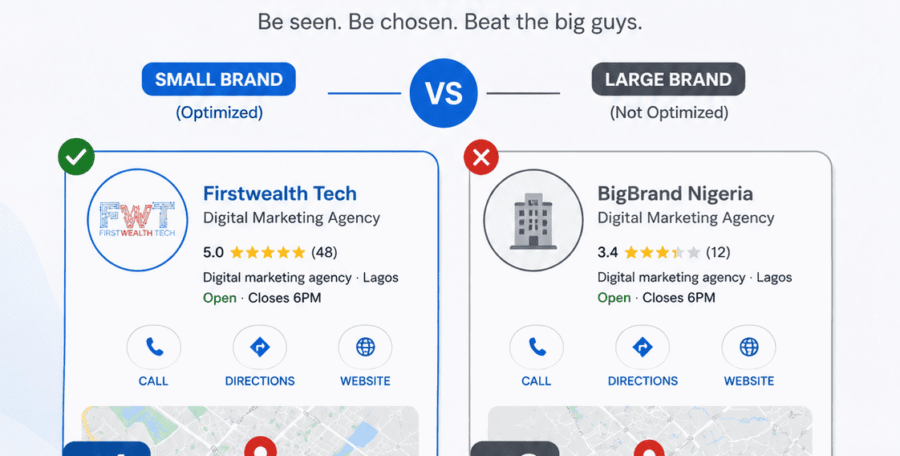
This is the single most powerful equaliser available to Nigerian small businesses competing online. Large brands focus on national or global rankings. They rarely invest seriously in the local map pack the three businesses shown at the top of Google results for location-specific searches like “accountant in Ikeja” or “caterer near me in Abuja.”
That creates a gap. A small Nigerian business with a fully optimised Google Business Profile, consistent citations across Nigerian directories, and 50 genuine customer reviews will consistently outrank a much larger competitor that has neglected its local presence.
Local SEO does not require a large budget. It requires consistent regular GBP posts, active review management, accurate NAP across every directory, and locally-relevant content that signals to Google you serve a specific community rather than a generic national audience. For a full breakdown of exactly how to implement this, see our guide on SEO for Small Local Business in Nigeria.
Strategy 3: Out-Authenticate Big Brands With Real Content
Large brands produce polished, heavily produced content that looks consistent but rarely feels personal. The authenticity gap the space between corporate content and genuine human communication is where small Nigerian businesses can win decisively.
Content that performs well for small Nigerian businesses competing against bigger brands includes:
- Behind-the-scenes content: showing how products are made, how services are delivered, who the team is. A small bakery in Port Harcourt showing its production process builds more trust than a national brand’s generic advertisement.
- Customer stories and testimonials: real people, real results, real names and faces. This is content that big brands struggle to replicate at a genuine level because their customer relationships are transactional at scale.
- Founder-led content: where the business owner shares expertise, opinions, and experiences directly. People trust people more than they trust brands, and a founder who shows up consistently online builds a following that no advertising budget can buy.
- Community-specific content: blog posts, videos, or social media content that speaks directly to the reality of living, working, or buying in a specific Nigerian city, neighbourhood, or community
When small businesses double down on niche marketing, they avoid competing with big brands on scale, and instead win through relevance, personalisation, and community trust. According to Nielsen’s Global Trust in Advertising report, 92% of consumers trust recommendations from friends and family over any form of paid advertising a finding that consistently favours smaller, community-rooted businesses over large corporations whose customer relationships are transactional at scale. This is not a consolation prize it is a genuinely superior competitive position for many categories.
Strategy 4: Build an Owned Audience, Not Just Social Media Reach
Social media platforms are borrowed land. An algorithm change, a policy update, or a platform decline can erase years of built-up reach overnight. Big brands can absorb this, they have the budget to rebuild. Small businesses often cannot.
The strategic advantage for a small Nigerian business is building an owned audience in parallel: an email list, a WhatsApp broadcast list, or both. These are communication channels the business controls directly, with no algorithm deciding who sees each message.
An email list of 500 genuinely interested subscribers who actually open your messages is worth more to most Nigerian SMEs than 5,000 Instagram followers who see your posts only when the algorithm chooses to show them. For a full guide on building this asset, see our article on Email Marketing in Nigeria: How to Build a List That Actually Buys.
Strategy 5: Move Faster and Respond More Personally
Speed and personalisation are genuine competitive advantages that small Nigerian businesses hold over larger ones. A big brand’s customer complaint goes through a support system, a moderation process, and a response template. A small business owner can respond to that same complaint within minutes, personally, with a real solution and turn a dissatisfied customer into a loyal advocate in the process.
Apply this across every channel:
- Respond to every Instagram comment and DM within hours, not days
- Reply to every Google review personally both positive and negative
- Follow up on every inquiry via WhatsApp within 24 hours
- When something goes wrong, fix it visibly and quickly, and let the resolution be part of your public story rather than something handled quietly
Big brands cannot do this consistently at scale. Small businesses can, and the customers who experience it remember it.
Strategy 6: Invest in a Website That Builds Credibility
One of the most persistent ways large Nigerian brands maintain their dominance online is simply through the perceived credibility of a polished, professional website. Many smaller businesses undermine their own competitive position with websites that load slowly, look outdated, or fail to communicate what makes them the right choice.
A well-built website closes this gap entirely. A small Nigerian business with a fast, mobile-optimised, conversion-focused website competes on equal visual footing with any larger brand and can exceed them in the specific credibility signals that actually matter: real testimonials, clear service descriptions, genuine case studies, and a transparent pricing guide.
For everything involved in building a website that competes at this level, see our complete guide: The Complete Guide to Building a Business Website in Nigeria.
Strategy 7: Be Consistent Where Big Brands Are Inconsistent
A small business that shows up online every day posting, engaging, and optimising will always outperform the competitor with a ₦1 million budget who shows up inconsistently.
Consistency is perhaps the most underrated competitive strategy available to Nigerian small businesses. Large brands run campaigns in bursts: heavy spend for a period, then quiet. A small business that publishes one blog post per week, posts three times on Instagram, and sends a monthly email newsletter consistently, for 12 months, builds an accumulated presence that sporadic large-budget campaigns cannot easily displace.
The businesses that consistently win against larger competitors online in Nigeria are rarely the ones with the biggest budgets. They are the ones that show up the most consistently, in the channels where their specific audience actually is.
How Firstwealth Tech Can Help
At Firstwealth Tech, we help Nigerian businesses of all sizes build the digital presence and strategy needed to compete effectively online, not just against local peers, but against established brands with significantly larger resources. From SEO and content to web design and paid advertising, we build for results, not just visibility.
Explore our Digital Agency Services or book a free consultation to talk through your specific competitive situation.
FAQs
Yes. Search engines rank based on relevance, consistency, and quality, not business size or budget. Small Nigerian businesses that focus on local SEO, niche content, and consistent community engagement regularly outrank much larger competitors in the searches that actually drive conversions.
Local SEO is consistently the highest-return strategy, since large brands rarely optimise their local search presence seriously. A small business with a well-maintained Google Business Profile, genuine customer reviews, and locally-relevant content can dominate its area regardless of a competitor's national budget.
By competing on dimensions where budget is not the deciding factor: authenticity, community trust, speed of response, local relevance, and consistency. These are areas where small businesses hold a genuine structural advantage over large brands.
Niche marketing means focusing on a narrow, specific audience or product category rather than trying to appeal broadly. It helps small Nigerian businesses avoid direct competition with large brands on broad keywords, instead dominating specific searches where they can realistically win and where buyers are closer to a purchase decision.
An email list is an owned communication channel; unlike social media, no algorithm controls who sees your message. It allows a small business to maintain direct, consistent contact with its most engaged customers without depending on platforms that can restrict reach overnight.
Very important. A polished, fast-loading, mobile-optimised website closes the credibility gap between a small business and a larger competitor. Conversely, a poor website reinforces the perception that the smaller business is less professional or reliable.
Yes, and in many categories it outperforms it. Authentic behind-the-scenes content, founder-led posts, and real customer stories consistently generate stronger engagement and trust than polished corporate content, particularly on platforms like Instagram, TikTok, and WhatsApp.
It means being the clearest, most visible, most trusted option within a specific, narrow category a particular product type, a specific neighbourhood, or a defined customer segment. This is far more achievable and valuable for a small business than trying to compete broadly across a large market.
For local SEO specifically, consistent effort on Google Business Profile and reviews can produce visible improvement within 30 to 90 days. Content-driven authority building typically takes three to six months to generate meaningful organic traffic. Paid advertising can produce faster visibility, though at higher ongoing cost.
Paid advertising can be effective, but is most valuable when the business already has validated messaging, a converting website, and a clear understanding of its target audience. Without these foundations in place, ad spend often produces weak results regardless of budget size.