Social Media Marketing vs Google Ads: Which Works Better in Nigeria?
Once a Nigerian business decides to invest in paid digital advertising, the next question is almost always the same: should the budget go toward social media ads (Facebook, Instagram, TikTok) or Google Ads? Both can work extremely well. Both can also waste money quickly if used the wrong way for the wrong goal.
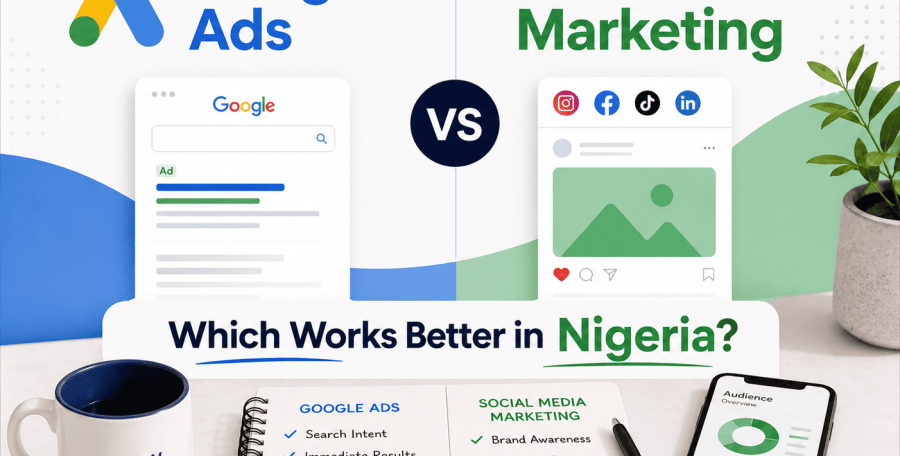
The honest answer is that social media marketing and Google Ads are not really competitors; they solve different problems. Social media is built for discovery: showing your product or service to people who weren’t necessarily looking for it yet. Google Ads is built for capture: showing up the moment someone is actively searching for exactly what you offer. Understanding this distinction is the real key to deciding where your budget goes, not simply asking which platform is “better.”
This guide compares both options on cost, intent, and results specifically for the Nigerian market, so you can decide where your next marketing budget should go.
How Each Platform Actually Works
Social media ads (primarily Meta’s Facebook and Instagram, alongside TikTok) work by showing your content to people based on their interests, behavior, demographics, and online activity, regardless of whether they were searching for your product at that exact moment. This makes social media excellent for building brand awareness and reaching people who didn’t know they needed your product yet.
Google Ads works differently. It shows your ad to people who are actively typing a relevant search into Google right now, “web design agency in Lagos” or “best caterer in Abuja.” This is intent-driven advertising: the person is already looking, and your ad simply needs to convince them to choose you over the other results.
Cost Comparison: Social Media vs Google Ads in Nigeria
This is usually the first question business owners ask, and in Nigeria specifically, the gap between the two platforms can be significant.
Social media advertising (Facebook/Instagram) in Nigeria typically costs between ₦50 and ₦300 per click, with Nigeria consistently ranking among the cheapest markets globally for Meta ad costs far below pricing in the US, UK, or other Tier 1 markets. Minimum daily budgets can start as low as ₦2,000-₦2,500, making social media ads accessible even for very small businesses just starting to test paid promotion.
Google Ads in Nigeria typically costs between ₦500 and ₦10,000 per click, depending heavily on how competitive your industry and keywords are. Highly competitive sectors like real estate, finance, and law tend to sit at the higher end of that range, while niche or local service businesses with less competition can pay significantly less.
In short, social media ads are usually the cheaper entry point, while Google Ads costs more per click but often delivers visitors who are already further along in their decision to buy.
Which One Delivers Better Results?
This depends entirely on what “better” means for your specific goal.
Choose social media marketing if:
- You’re building brand awareness for a new business or product
- Your offer is visual (fashion, food, beauty, real estate, events)
- You want to reach people who aren’t actively searching yet but would be interested if they saw your offer
- Your budget is limited, and you need to start small
Choose Google Ads if:
- You want to reach people who are already actively searching for what you offer
- Your business has a clear, definable service people search for by name (“plumber in Lekki,” “divorce lawyer in Abuja”)
- You’re comfortable paying more per click in exchange for higher purchase intent
- Your sales cycle benefits from capturing demand at the exact moment someone is ready to buy
Many growing Nigerian businesses eventually use both, but in different roles: social media to build awareness and warm up an audience, and Google Ads to capture the demand that awareness eventually creates.
A Word on Where the Click Actually Lands
Whichever platform you choose, the page a visitor lands on after clicking matters just as much as the ad itself. A great ad sending traffic to a slow, confusing, or outdated website wastes the entire ad budget before the visitor even has a chance to convert. If you suspect your website might be the weak link in your paid advertising results, our guide on 10 Signs of a Business Website Losing Customers is worth reviewing before you scale up ad spend on either platform.
This is also why a dedicated, conversion-focused landing page, rather than sending paid traffic to your homepage, tends to perform significantly better. The homepage is built to inform a broad audience; a landing page is built to convert one specific group of visitors with one specific offer.
Common Mistakes Nigerian Businesses Make With Paid Ads
- Running ads with no clear goal: Awareness, leads, and sales require different ad setups; running one generic campaign for all three usually underperforms.
- Sending traffic to a homepage instead of a dedicated landing page, which dilutes the specific message that earned the click in the first place.
- Stopping a campaign too early: Paid ads often need a short learning period before performance stabilizes; pulling the plug after a few days rarely gives an accurate picture.
- Ignoring follow-up: A click or a lead is not a sale. Nigerian businesses that follow up quickly via WhatsApp or phone after a lead comes in convert significantly more than those that wait.
- Comparing platforms by cost-per-click alone, without factoring in how qualified or ready-to-buy the resulting traffic actually is.
Budgeting Realistically for Either Platform
A small business in Nigeria can realistically start testing social media ads with a budget as low as ₦20,000-₦50,000 for an initial two-week test. Google Ads generally requires a slightly larger starting budget, often ₦100,000-₦300,000 per month, to gather enough data and clicks to judge performance meaningfully, particularly in more competitive industries. Whichever platform you choose, starting with a modest, clearly defined test budget and adjusting based on real results is far more effective than guessing at a large budget upfront.
How Firstwealth Tech Can Help
At Firstwealth Tech, we help Nigerian businesses decide where their advertising budget will actually work hardest, then manage the campaigns, the landing pages, and the follow-up process needed to turn clicks into customers. Explore our Social Media Marketing Services and PPC Advertising Services, or get a free strategy consultation, and we’ll help you decide where to start.
FAQs
It depends on your goal. Social media ads work well for building awareness among people who aren't actively searching yet, while Google Ads works best for capturing people who are already searching for exactly what you offer. Many businesses benefit from using both at different stages.
Social media ads in Nigeria typically cost between ₦50 and ₦300 per click, with minimum daily budgets starting as low as ₦2,000–₦2,500, making it one of the most accessible paid advertising options for Nigerian SMEs.
Google Ads in Nigeria typically costs between ₦500 and ₦10,000 per click, depending on how competitive your industry and chosen keywords are. Highly competitive sectors like real estate and finance tend to cost more per click than niche or local services.
Google Ads targets people actively searching with clear buying intent, which makes that traffic more valuable and competitive among advertisers. Social media ads target people based on interests and behavior rather than active searches, which generally keeps costs lower.
Yes, though it typically requires a larger starting budget than social media ads to gather enough data for meaningful results, often ₦100,000–₦300,000 per month, depending on the industry. Starting with a focused, niche keyword strategy can make it more affordable.
A dedicated landing page built specifically around the ad's offer typically performs significantly better than sending traffic to a general homepage, since it keeps the visitor focused on one specific action rather than the broader, less targeted content of a homepage.
Most paid ad platforms need a short learning period, often at least one to two weeks, before performance stabilizes. Judging a campaign too early, based on only a few days of data, often leads to inaccurate conclusions.
No. While social media is particularly strong for awareness, it can also drive direct sales, especially for visual products and impulse purchases, when paired with strong creative, clear offers, and a smooth path to checkout or contact.
Yes, and many growing Nigerian businesses do exactly this using social media to build awareness and warm up potential customers, then using Google Ads to capture demand once that awareness translates into active searching.
The most common mistake is running ads without a clear goal or sending traffic to a homepage instead of a dedicated landing page, both of which significantly reduce how many clicks actually turn into leads or sales.