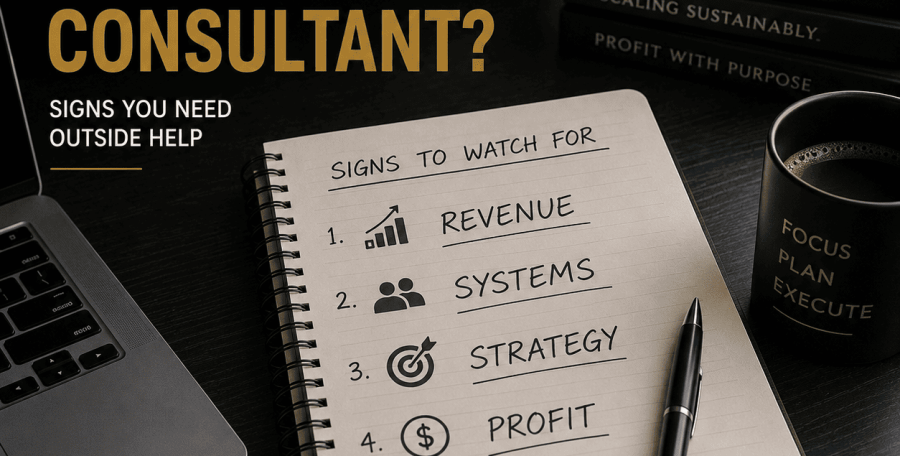
When Should Your Business Hire a Consultant? (Signs You Need Outside Help)
Most Nigerian business owners wait too long before bringing in outside help. By the time a consultant is called in, the problem has usually been quietly compounding for months; revenue has been flat for two quarters, a key hire has not worked out, or a major decision has already been made without enough information to make it well.
The best time to bring in a consultant is rarely when things have already fallen apart. It is earlier when the business has hit a ceiling it cannot see clearly from the inside, or when a decision is on the table that carries enough weight to make getting it wrong genuinely expensive. This guide walks through the clearest signs that a Nigerian business needs outside expertise, what to expect from a consulting engagement realistically, and how to know if a consultant you are considering is actually the right fit.
What a Business Consultant Actually Does
Before deciding whether your business needs one, it helps to be clear about what a consultant actually provides. A business consultant is an outside expert hired to analyse a specific problem, provide objective recommendations, and, depending on the engagement, help implement those recommendations directly.
This is different from a business coach, who helps develop the owner’s thinking and leadership skills, and different from a mentor, who offers informal guidance based on their own experience. A consultant’s value lies in the combination of outside perspective, specialist knowledge, and freedom from the internal politics and assumptions that make it hard for anyone inside a business to see it clearly.
Sign 1: Revenue Has Plateaued Without a Clear Explanation
This is the most common trigger for a consulting engagement and often the most delayed. Revenue was growing, then it stopped not dramatically, but stubbornly. The team is working just as hard; the product or service has not changed, but new customers are harder to find, and existing ones are not spending more.
The instinct is usually to push harder on whatever was working before. In most cases, this does not fix the plateau because the cause is structural: a pricing model that has stopped fitting the market, a customer acquisition channel that has been exhausted, or a competitive dynamic that has shifted and not something that can be solved by effort alone.
An outside consultant can assess the business without the blind spots that come from being inside it, and identify whether the plateau is tactical (a fixable marketing or sales problem) or strategic (a deeper shift in positioning or product that the whole team has been avoiding discussing).
Sign 2: The Business Cannot Run Without You
If every significant decision, every client issue, every hire, every supplier negotiation needs to go through the founder or a single key person, the business has a dependency problem that caps how large it can ever grow. A business that cannot function at full capacity without one person is not scalable; it is a highly skilled job that happens to have staff around it.
This is one of the most common structural problems in Nigerian SMEs. Founders who built the business from scratch are often reluctant to delegate meaningfully, partly from habit and partly from the genuine risk that early-stage businesses face when key decisions are made badly. But founder-reliant businesses consistently sell at a lower valuation, struggle to attract senior talent, and hit a ceiling that the founder’s own working hours define.
A consultant in this situation does not take over operations; they help build the systems, decision-making frameworks, and management structures that allow the business to operate consistently without the founder touching every decision.
Sign 3: You’re About to Make a High-Stakes Decision
Some decisions are expensive to get wrong: entering a new market, launching a major new product line, a significant hiring decision, a partnership or acquisition, or a major investment in infrastructure or technology. These moments are often when consulting support delivers its highest return, because the cost of an engagement is modest compared to the cost of the wrong decision at scale.
The value here is not just analysis; it is the outside perspective of someone who has seen similar decisions made in similar businesses, and who has no internal incentive to tell you what you want to hear. Many Nigerian business owners confide that the most valuable thing a consultant provided was simply telling them their plan had a serious flaw before they acted on it, rather than after.
Sign 4: Growth Is Happening, But Profitability Isn’t
A growing business that is becoming less profitable is a business with an operational or pricing problem that will only get worse as volume increases. This counterintuitive situation revenue going up while margins go down is common in Nigerian SMEs that are scaling their operations without the structure to support growth efficiently.
Common causes include: costs that are rising faster than revenue, underpricing that becomes more damaging at higher volume, a customer mix that has shifted toward lower-margin clients, or operational inefficiencies that small-scale working around but become painful at scale. A consultant with financial and operational experience can identify which of these is actually driving the problem rather than guessing.
Sign 5: The Same Problems Keep Recurring
If the same issues a certain type of client complaint, a recurring cash flow crunch at a specific time of year, a pattern of hiring that doesn’t work out keep appearing despite repeated attempts to fix them, the likely explanation is that the real root cause has not been identified. Treating symptoms without diagnosing the underlying cause is one of the most common ways Nigerian businesses spend money without getting better.
An outside consultant approaches these recurring problems without the assumptions that build up over years of being inside a business. What feels like a people problem is sometimes a process problem. What feels like a marketing problem is sometimes a pricing problem. Fresh eyes on familiar issues often produce the first real diagnosis rather than another workaround.
What a Good Consulting Engagement Looks Like
Knowing you need a consultant is one thing. Knowing what to expect from the engagement is another. A few principles that separate productive consulting engagements from expensive ones:
- A good consultant starts by asking more than they tell. The first phase of any serious consulting engagement should be understanding your specific situation, not applying a generic framework immediately.
- The scope should be clearly defined upfront. Vague engagements with no specific deliverables tend to drag and disappoint. Know what you are getting: a strategic assessment, a growth plan, a financial model, a process redesign.
- Implementation matters as much as recommendations. A report that sits on a shelf is worth nothing. Before engaging, agree on how recommendations will be translated into action and what support will be available during that transition.
- Results should be measurable. Even in strategy work, define what success looks like, what metric will have changed, and by when, if the engagement has worked.
When a Consultant Is Not What You Need
Not every business problem requires a consultant. If the issue is primarily skills development in the founder or leadership team, a coach or mentor may be more appropriate; organisations like SCORE offer free mentoring from experienced business professionals and are worth exploring if structured mentorship rather than problem-specific consulting is what the business needs. If the problem is purely technical and narrow in scope, a specialist freelancer is often a more efficient option than a consulting engagement. And if the business is too early-stage to have identified a specific, meaningful problem, a consulting investment often produces less value than simply going out and finding more customers first.
The right consulting engagement solves a clearly defined problem that the business cannot solve efficiently on its own. Broad, undefined engagements (“help us grow”) rarely deliver the same value as narrowly scoped ones (“help us diagnose why our margin has been declining for three quarters and identify the three highest-leverage fixes”).
How to Choose the Right Consultant for Your Nigerian Business
When selecting a consultant, look for:
- Evidence of having solved the same type of problem in businesses similar to yours, ideally in the Nigerian market, since local context matters
- A clear explanation of their process: a competent consultant should be able to tell you exactly how they will approach your problem and what you will receive at the end
- References from real clients, ideally in similar sectors, with specific outcomes they can describe
- A payment structure tied to deliverables, not purely to time; this aligns incentives toward results rather than hours billed.
How Firstwealth Tech Can Help
At Firstwealth Tech, our consulting services are structured around clearly defined problems with specific, measurable outcomes, not open-ended retainers that bill you for conversations. Whether you need strategic clarity, operational restructuring, or a growth plan built on real data, we bring both the outside perspective and the implementation support to make it actionable.
Explore our Business Consulting Services and Individual Consulting Services, or book a free appointment to talk through your specific situation before committing to anything.
FAQs
The clearest signals are: revenue has plateaued without explanation, the business cannot function without the founder, a high-stakes decision is imminent, growth is happening, but profitability isn't, or the same problems keep recurring despite repeated attempts to fix them.
A consultant analyses a specific business problem and provides recommendations or implementation support to solve it. A coach focuses on developing the owner's own thinking and leadership capacity, rather than directly solving a defined problem.
No. Mid-sized SMEs often get the highest return from consulting because decisions at this stage have a compounding impact; the right strategic move or the right structural fix at the growth phase can determine whether the business scales or stalls.
Ask for specific results they have delivered for similar businesses, a clear explanation of their process, and measurable deliverables tied to your specific problem. A consultant who cannot tell you clearly what you will receive or how success will be measured is rarely worth the investment.
Expect a structured process: initial discovery (understanding your situation), diagnosis (identifying the real problem), recommendations, and ideally support during implementation. A serious engagement produces specific, actionable outputs, not just a presentation of observations.
This varies by scope. A strategic assessment might take two to four weeks. A growth plan or operational restructure typically runs one to three months. Ongoing advisory retainers can extend much longer, but most specific problem-solving engagements are time-bounded.
Yes, identifying the root cause of declining margins or cash flow problems is one of the most common consulting briefs. The earlier this intervention happens, the more options are available; waiting until the crisis is advanced significantly limits what can be done.
Defining the scope too broadly ("help us grow") rather than around a specific, measurable problem. Vague engagements produce vague results, while narrowly scoped ones "diagnose why our customer acquisition cost has tripled in six months" tend to deliver clear, actionable outcomes.
For most Nigerian SMEs, a consultant with direct experience in the Nigerian market, its regulatory environment, consumer behaviour, and operational realities typically delivers more immediately applicable advice than one with broad international experience but limited local context.
Before the engagement starts, document the problem as specifically as possible, gather whatever data you have on the business (financials, sales figures, operational data), and identify the decision or outcome the engagement should enable. The more clearly you can define what success looks like, the more focused and valuable the consultant's work will be.