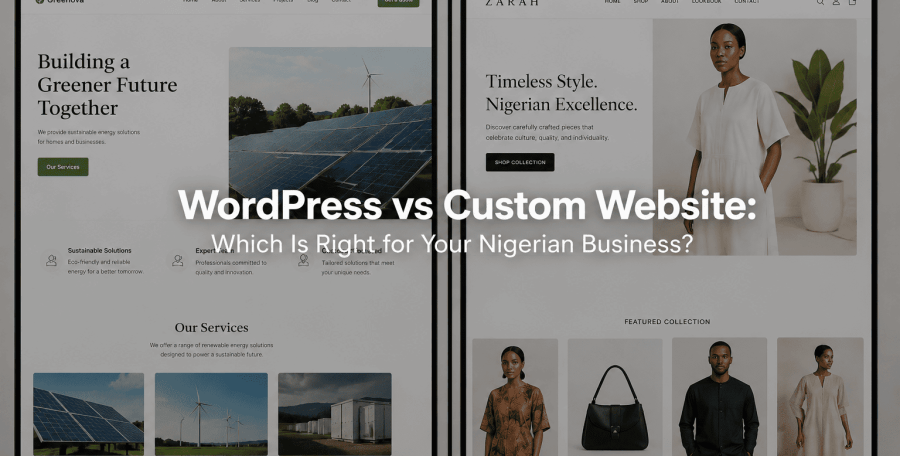
WordPress vs Custom Website: Which Is Right for Your Nigerian Business?
One of the first decisions every Nigerian business owner faces when building a website is which platform to build it on. The two most common paths are WordPress, the world’s most widely used website platform, and a custom-built website, developed from scratch specifically for your business.
Both are legitimate choices. Both can produce a professional, high-performing website. The right answer depends entirely on your budget, how the site will be used day to day, and how much you expect your business to grow over the next few years. This guide breaks down exactly how WordPress and custom websites compare on cost, speed, security, and long-term flexibility, with specific guidance for what makes sense for a Nigerian business.
What Is WordPress?
WordPress is an open-source content management system (CMS) that powers a large share of websites globally. It lets you build a website using pre-designed themes and add functionality through plugins, without writing code from scratch. Its admin interface is widely used and well understood, which means it’s relatively easy to find developers and support in Nigeria who already know how to work with it.
WordPress works well for brochure sites, blogs, service-based business websites, and small to medium e-commerce stores (using a plugin called WooCommerce).
What Is a Custom Website?
A custom website is built entirely from scratch using code tailored specifically to your business, rather than relying on pre-built themes or a plugin ecosystem. This gives complete control over design, functionality, and performance, but requires more development time and a higher upfront investment.
Custom websites tend to suit businesses with very specific requirements, complex integrations, unique user experiences, or performance demands that a theme-and-plugin approach cannot satisfy well.
WordPress vs Custom Website: Side-by-Side Comparison
| Factor | WordPress | Custom Website |
| Upfront cost | Lower — typically ₦150,000–₦600,000 for most Nigerian SME sites | Higher — often ₦800,000–₦5,000,000+ depending on complexity |
| Time to launch | Faster, often 2–4 weeks | Longer, often 6–12+ weeks |
| Ease of self-editing content | Easy — built for non-technical users to update text, images, and pages | Limited — usually requires a developer for most changes unless a custom CMS is built in |
| Speed/performance | Good, but depends heavily on hosting quality and the number of plugins used | Generally faster, since there’s no plugin overhead weighing the site down |
| Security | Requires regular updates; a frequent target for attacks due to its popularity | Smaller attack surface, but security depends entirely on how well the custom code is built and maintained |
| Flexibility/scalability | Covers the vast majority of SME needs; can hit limits for highly specific or complex features | Built to scale exactly to your specifications, with no plugin constraints |
| Long-term maintenance cost | Ongoing — plugin updates, theme updates, security monitoring | Varies — can be lower if the site is simple and stable, or higher if frequent feature changes are needed |
| Best for | Most Nigerian SMEs, service businesses, blogs, and small-to-medium online stores | Businesses with complex, specific, or highly customized functionality needs |
Cost: Where the Real Difference Lies
For most Nigerian SMEs, this is the deciding factor. A professionally built WordPress website typically costs significantly less upfront than a custom build, since development time is reduced by using existing themes and plugins as a foundation. For a full breakdown of pricing by website type, see our complete guide: How Much Does a Professional Website Cost in Nigeria? (2026 Pricing Guide).
That said, cost should be considered over time, not just at launch. WordPress sites often carry ongoing costs for plugin updates, security monitoring, and occasional fixes when plugins conflict with each other. Custom websites have a higher starting cost but can sometimes be cheaper to maintain over several years if built well and kept simple, since there’s no plugin ecosystem to manage. For most growing Nigerian businesses still establishing their online presence, however, the lower upfront cost of WordPress makes it a more practical starting point.
Speed and Performance
Custom websites generally have an edge here, since they aren’t carrying the overhead of a CMS and multiple plugins running in the background. However, a well-optimized WordPress site using quality hosting, a lightweight theme, and a minimal set of well-maintained plugins can perform very well. The biggest performance risk with WordPress isn’t the platform itself, but poor implementation: too many plugins, low-quality hosting, and unoptimized images. If your current WordPress site feels slow, the issue is more often the setup than the platform.
Security Considerations
WordPress’s popularity is a double-edged sword. Because it powers such a large share of websites worldwide, it is also one of the most frequently targeted platforms by attackers, with thousands of WordPress sites compromised daily across the globe, usually through outdated plugins, weak passwords, or unpatched core files rather than a flaw in WordPress itself.
Custom websites have a smaller attack surface simply because there’s less third-party code involved, but this doesn’t make them automatically more secure. Security on a custom site depends entirely on how carefully it was built and maintained. In both cases, ongoing attention to updates and security practices matters more than the platform choice alone.
Who Manages Content Day-to-Day?
This is an often-overlooked factor that matters a lot in practice. WordPress was built so that non-technical users can log in and update text, swap images, or publish a blog post without touching code. This independence is valuable for businesses that want to keep their website current without paying a developer for every small change.
Custom websites can be built with a content management system included, but this adds to development cost and complexity. Without one, most changes require going back to a developer, which can slow things down and add ongoing cost for routine updates.
If your business plans to publish content regularly, such as blog posts, service updates, and new product listings, this is a significant point in WordPress’s favor.
When WordPress Makes Sense for a Nigerian Business
WordPress is generally the right choice if:
- You’re a small or medium-sized business that needs a professional website without a large upfront budget
- You want to manage and update content yourself without ongoing developer costs
- Your needs are well-served by existing themes and plugins (most service businesses, blogs, and small online stores fall into this category)
- You want to launch relatively quickly
When a Custom Website Makes Sense
A custom build is worth the higher investment if:
- You need very specific functionality that no plugin or theme combination can deliver well
- Performance at scale is critical to your business (high-traffic platforms, complex web applications)
- You’re building something closer to a software product than a traditional website, a booking platform, a marketplace, a fintech tool
- You have the budget and timeline to support a longer development process
For most Nigerian SMEs, just establishing or upgrading their online presence, WordPress covers the vast majority of needs. Custom development becomes the better investment once a business has outgrown what a theme-and-plugin approach can reasonably support.
A Middle Ground Worth Knowing About
Some businesses choose a hybrid approach: a WordPress backend for content management, paired with a faster, more custom-built front end that visitors actually see. This gives a marketing or content team the easy editing experience of WordPress, while delivering better speed and more design flexibility than a typical theme-based site. It costs more than a standard WordPress build but less than a fully custom website, and is worth discussing with your developer if you want the benefits of both approaches.
Making the Right Choice for Your Business
The right platform depends less on which technology is “better” in general and more on what your specific business needs right now. If you’re still unsure which fits your situation, our complete resource, The Complete Guide to Building a Business Website in Nigeria, walks through the full decision-making process, from planning through launch.
How Firstwealth Tech Can Help
At Firstwealth Tech, we build both WordPress and custom websites for Nigerian businesses, and we’ll recommend the option that genuinely fits your goals and budget rather than pushing whichever is more profitable for us. If you’re unsure which direction makes sense, we’re happy to walk through your specific needs together.
Get a free consultation, and we’ll help you decide between WordPress and custom development based on your business’s actual needs.
FAQs
For most Nigerian SMEs, WordPress offers a better balance of cost, speed to launch, and ease of self-managing content. A custom website becomes the better choice once a business has specific, complex needs that themes and plugins cannot reasonably support.
Custom websites typically cost significantly more upfront than WordPress, often two to five times more depending on complexity, since every feature is built from scratch rather than using existing themes and plugins as a foundation.
Yes, when properly maintained. Most WordPress security issues come from outdated plugins, weak passwords, or unpatched updates rather than a flaw in WordPress itself. Regular updates and quality hosting significantly reduce the risk.
Yes. WordPress is specifically designed so non-technical users can log in and update text, images, and pages without needing a developer for routine changes, which is one of its biggest advantages for small business owners.
Generally, yes, since custom websites don't carry the overhead of a CMS and multiple plugins. However, a well-optimized WordPress site with quality hosting and minimal plugins can still perform very well for most business needs.
Yes. Using a plugin called WooCommerce, WordPress can support small to medium-sized online stores effectively, including product catalogues, payment integration, and inventory management. Very large stores with complex requirements may eventually benefit from a more custom approach.
Common signs include needing functionality that no plugin combination can deliver well, performance issues that persist despite optimization, or requirements closer to a software platform than a traditional website. If you're unsure, a developer can assess your specific needs
It depends on the specific project. WordPress carries ongoing costs for plugin and theme updates, while custom websites can be cheaper to maintain if built simply, but more expensive if frequent feature changes are needed. Total cost over several years should be considered, not just the upfront price.
is a common path. Many businesses start with WordPress to launch quickly and affordably, then move to a custom build once they have a clearer sense of their specific long-term needs and the budget to support it.
Yes. Some businesses use WordPress as a content management backend paired with a custom-built front end, combining WordPress's easy content editing with better speed and design flexibility than a typical theme-based site, at a cost between the two standard options.