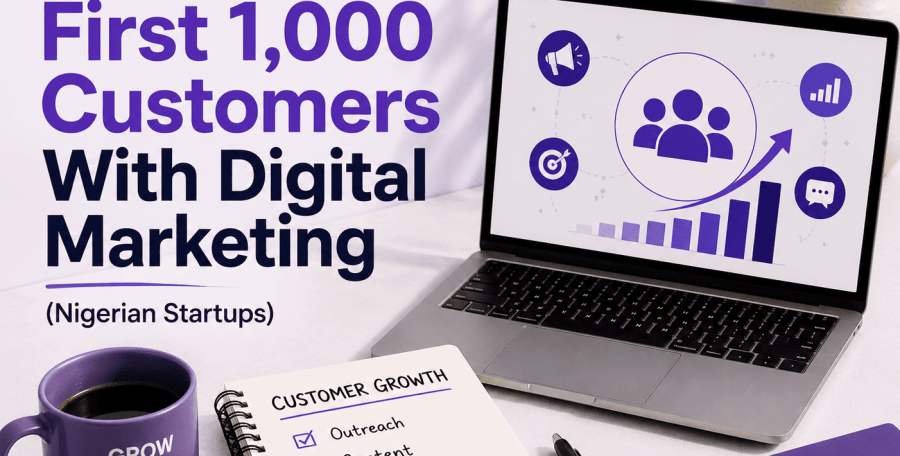
How to Get Your First 1,000 Customers With Digital Marketing (Nigerian Startups)
Every successful Nigerian business, no matter how big it eventually becomes, started with zero customers. The first 1,000 is widely considered the hardest milestone to reach, harder in many ways than the next 10,000, because at this stage you have no word-of-mouth, no case studies, and no real proof that your offer works. You are not yet a company; you are a hypothesis still looking for confirmation.
The good news is that getting your first 1,000 customers does not require a huge budget or a viral moment. It requires a deliberate, staged approach, doing the unscalable, hands-on things early, then gradually layering in content, community, and paid promotion as you learn what actually works. This guide walks through exactly how Nigerian startups can apply this approach using digital marketing, stage by stage.
Why the First 1,000 Customers Matter So Much
Reaching 1,000 customers is not just a vanity number. It is typically the point where you have enough data to know if people genuinely want what you are offering, not just sign up out of curiosity and disappear. It is also roughly the threshold where word-of-mouth and referrals start becoming a meaningful growth engine on their own, rather than something you have to manufacture entirely through paid effort.
Before chasing this number through marketing, it is worth being honest about one thing: no amount of marketing saves a product or service that does not genuinely solve a problem. If early customers are not satisfied enough to refer others, that is a signal to revisit the offer itself before scaling spend on acquisition.
Stage 1: Do Things That Don’t Scale (Your First 50–100 Customers)
In the earliest stage, the most effective strategies are the ones that feel inefficient and very hands-on, because at this size, personal effort outperforms broad marketing every time.
- Start with your existing network: Talk to friends, family, and their networks. Ask about their pain points related to what you offer rather than pitching immediately. Early customer development is about learning, not selling yet.
- Show up in communities where your audience already gathers: For Nigerian startups, this often means relevant WhatsApp groups, Twitter/X Spaces, Facebook groups, or niche communities tied to your industry, rather than generic broad platforms.
- Offer a few people a personalized, hands-on experience: Reach out individually, offer to onboard them personally, and ask directly for feedback. This kind of attention does not scale, but it builds the trust and word-of-mouth that everything else depends on later.
- Incentivize referrals from your earliest customers: Your next group of customers will often come directly from your first group, especially if you make it easy and rewarding for them to refer people they know.
This stage typically does not require any advertising budget at all. It requires time, direct outreach, and a genuine willingness to learn from early feedback rather than defend your original idea.
Stage 2: Build Content That Attracts People Already Searching (The Next 100–500)
Once you have a small base of paying or active customers and have refined your offer based on their feedback, the next stage is building content that reaches people who are already looking for a solution to the problem you solve, even if they have not heard of you yet.
This is where SEO and content marketing become valuable. Rather than writing about your product directly, write about the problem your product solves. A Nigerian fintech startup, for example, might write about budgeting struggles or saving challenges rather than only describing its own features. This approach attracts people through genuine search intent rather than interrupting them with an ad.
For a full breakdown of how to do this properly, see our guides on SEO for Nigerian Businesses: A Beginner’s Guide to Ranking on Google and Content Marketing for Nigerian Businesses: How to Attract Clients With Blog Posts. A small number of well-targeted, genuinely useful articles can start driving steady, free traffic within a few months, and that traffic compounds over time rather than disappearing the moment you stop paying for it.
Stage 3: Layer In Paid Advertising Strategically (Scaling Toward 1,000)
Paid advertising works best once you already understand your offer, your messaging, and roughly who responds to it. Jumping into ads before this point often means paying to learn lessons that organic, low-cost methods could have taught you for free.
Once you have a clearer sense of your ideal customer:
- Start with a small, defined test budget rather than a large, vague one. A few weeks of focused spending with clear tracking teach you more than a large budget spread across unclear goals.
- Choose the platform based on intent, not habit: Social media ads work well for building awareness among people who are not yet searching; Google Ads works well for capturing people who are already actively looking. Our guide on Social Media Marketing vs. Google Ads: Which Works Better in Nigeria? breaks down exactly how to choose between them.
- Send traffic to a focused landing page, not your homepage: A page built around one specific offer converts significantly better than a general homepage built to inform a broad audience.
- Track click-through rate and conversion rate, not just impressions: Generating attention without action is a common, costly trap for early-stage Nigerian startups testing ads for the first time.
Stage 4: Make Sure What You’re Sending Traffic To Actually Converts
All of the acquisition efforts above can be undermined by one overlooked factor: a website or landing page that loses visitors before they convert. A confusing layout, slow loading speed, or unclear next step can quietly erase a large share of the leads your marketing efforts work hard to generate.
Before scaling any channel further, it is worth auditing your own site against common conversion killers. Our guide on 10 Signs of a Business Website Losing Customers covers exactly what to check, and What Makes a High-Converting Website? A Breakdown for Nigerian SMEs outlines what a properly optimized page should include.
Building Momentum: Why Consistency Beats Intensity
A common pattern among Nigerian startups is going all-in around a launch moment, then losing momentum once the initial excitement fades. In reality, the majority of early customers tend to come not from the launch itself, but from the sustained effort that follows over the following weeks and months, continued content, continued community engagement, and continued outreach.
Treat the path to 1,000 customers as a consistent weekly habit rather than a single campaign. Showing up reliably with clear messaging builds the familiarity that eventually turns into trust, and trust is what actually drives conversions, referrals, and repeat business.
A Simple Staged Checklist
- Validate your offer through direct conversations with your existing network
- Build a small, engaged base through hands-on onboarding and incentivized referrals
- Start publishing content that addresses real customer problems, not just your product
- Once messaging is validated, test paid advertising with a small, focused budget
- Continuously check that your website or landing page converts the traffic you’re sending it
- Track real metrics (conversion rate, referral rate, repeat usage) rather than vanity numbers like reach or impressions alone
How Firstwealth Tech Can Help
At Firstwealth Tech, we help Nigerian startups build the digital marketing foundation needed to reach their first 1,000 customers and beyond, from SEO and content strategy to paid advertising and conversion-focused website design. Explore our Digital Agency Services or get a free strategy consultation, and we’ll help you map out the right approach for your stage of growth.
FAQs
This varies significantly by industry and offer, but most startups take several months to a year, with momentum often building gradually rather than all at once. Consistency in outreach, content, and follow-up tends to matter more than speed.
Generally, paid ads work best after you have validated your offer and messaging through more hands-on methods like direct outreach and community engagement. Paying for ads before this point often means spending money to learn lessons that free methods could teach just as effectively.
Direct, personal outreach to your existing network, combined with active participation in relevant online communities (WhatsApp groups, Twitter/X Spaces, niche Facebook groups), tends to be the fastest and most cost-effective way to reach the first 100 customers.
Yes. SEO and content marketing help startups reach people who are already searching for solutions to the problem they solve, generating steady traffic over time without ongoing ad spend. Results typically take a few months to build but compound significantly afterward.
Very important. A strong share of a startup's next set of customers typically comes directly from referrals made by earlier satisfied customers, which is why incentivizing and actively encouraging referrals early is one of the highest-leverage actions a startup can take.
The most common mistake is jumping straight into paid advertising before validating the offer and messaging through direct, low-cost methods, which often results in wasted ad spend without a clear understanding of what's actually working.
No, generally a dedicated landing page focused on one specific offer converts significantly better than a general homepage, which is built to inform a broad audience rather than convert a specific group of visitors.
A good sign is when your early customers are genuinely satisfied and naturally refer others without much prompting. If this isn't happening, it's often more valuable to refine the offer itself before investing heavily in acquisition.
Conversion rate, referral rate, and repeat usage are more meaningful than vanity metrics like reach or impressions, since they reflect whether people are actually finding value in what you offer rather than simply seeing your marketing.
Yes. Many startups reach this milestone primarily through direct outreach, community engagement, referrals, and organic content, layering in paid advertising only once messaging has been validated and a clear understanding of customer acquisition cost has been established.